
Your Website Traffic Isn’t Down. The Web Is.
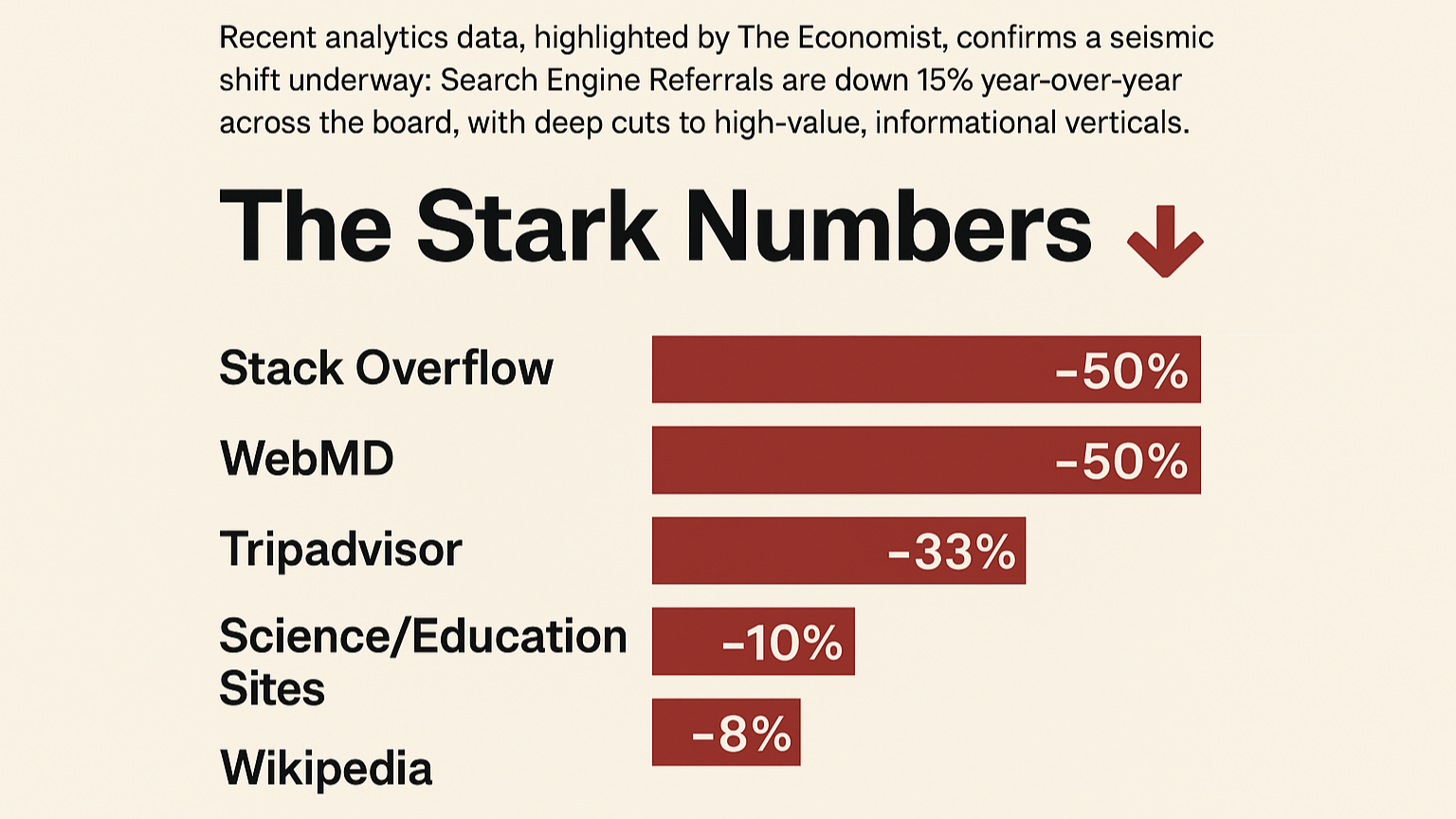
In the last few months, a set of analytics data—brought into the mainstream by The Economist—has confirmed what many digital professionals have sensed for over a year: the ground beneath the internet is shifting. Not gradually. Not subtly. But dramatically.
Search Engine Referrals, once the oxygen of the open web, are down 15% year-on-year across virtually every category. And the decline is not evenly distributed—it is hitting the highest-value, most information-dense verticals the hardest.
This isn’t a blip.
This isn’t poor SEO.
This is the beginning of a new era where people no longer search—they ask.
Welcome to the AI-First Web.
The Numbers Are Brutal
The latest analytics paint a stark picture:
Stack Overflow: –50%
WebMD: –50%
Tripadvisor: –33%
Science & Education Sites: –10%
Even Wikipedia: –8%
These are not fringe blogs or small content publishers. These are the giants that have shaped how we consume information for over two decades.
If they are losing this much visibility, what chance does a mid-size blog, SaaS knowledge base, or e-commerce content strategy have?
Why This Is Happening: The AI Funnel Has Replaced the Search Funnel
For years, the internet operated on a simple model:
User searches a question.
Google shows links.
Users click into websites.
Websites earn from ads, products, or subscriptions.
Websites produce more content.
Traffic fed revenue.
Revenue fed content.
Content fed search.
Search fed traffic.
A brilliantly self-reinforcing ecosystem.
Then came AI Overviews, SGE, and generative chatbots.
Now the flow looks more like:
User asks a question.
Google, Bing, or ChatGPT answers directly.
The model summarises hundreds of sources.
The user never leaves the interface.
Clicks disappear.
Pages go unvisited.
Content sits unseen.
The funnel is collapsing at the very top.
We used to Google.
Now we ask Chat.
And when the bot has already ingested the world’s text, there’s simply no reason left to click.
The Consequences: A System at Risk
This shift sounds convenient for users—but it comes at a cost.
Without traffic, there’s no advertising revenue.
Without revenue, there’s no incentive to produce high-quality content.
Without content, AI has nothing left to train on.
It’s a slow-motion loop that risks:
weaker online communities
fewer expert-driven knowledge bases
the decline of independent journalism
homogenised information
models learning from their own output, not human insight
In short: the open web is starting to starve.
The Rise of the “Walled Answers” Era
For the first time since Google launched, information is being centralised back into proprietary walled gardens:
Google summarises your site, but keeps the user.
OpenAI quotes your content, but replaces the visit.
Bing synthesises your data, but owns the interaction.
The web was built on hyperlinks.
AI is built on endpoints.
This is a profound cultural shift. And we’re just at the beginning.
So What Happens Next?
The winners in an AI-first world will be those who adapt early. We may be entering a landscape where:
1. Brands must build direct, owned audiences
Email lists, communities, and apps become critical. Relying on Google is no longer safe.
2. Content strategies must evolve beyond SEO
Top-of-funnel informational content will deliver diminishing returns. Differentiation, originality, and proprietary data will matter more than keywords.
3. Companies will need AI-ready content architectures
Structured data, API-based knowledge, and machine-readable content will become part of normal operations.
4. Trust and expertise will be brand moats
As generic content becomes commoditised, authentic voices and domain authority regain value.
5. Search will still exist—but as a transactional tool
Users may search only when they want to buy—not when they want to learn.
The Bottom Line
We’re living through the most significant shift in the internet since the invention of Google itself.
Search is no longer the primary gateway to knowledge.
AI is.
And while this new world brings tremendous convenience, it also fractures the underlying economic model that has powered the web for 25 years.
For creators, marketers, and businesses, the message is clear:
Adapt now—or risk becoming invisible.